
 (1).jpg)

How to get a VAT number in Italy, step by step
If your business is not established in Italy, VAT registration is still a formal administrative process. Here is the route to follow, simplified.
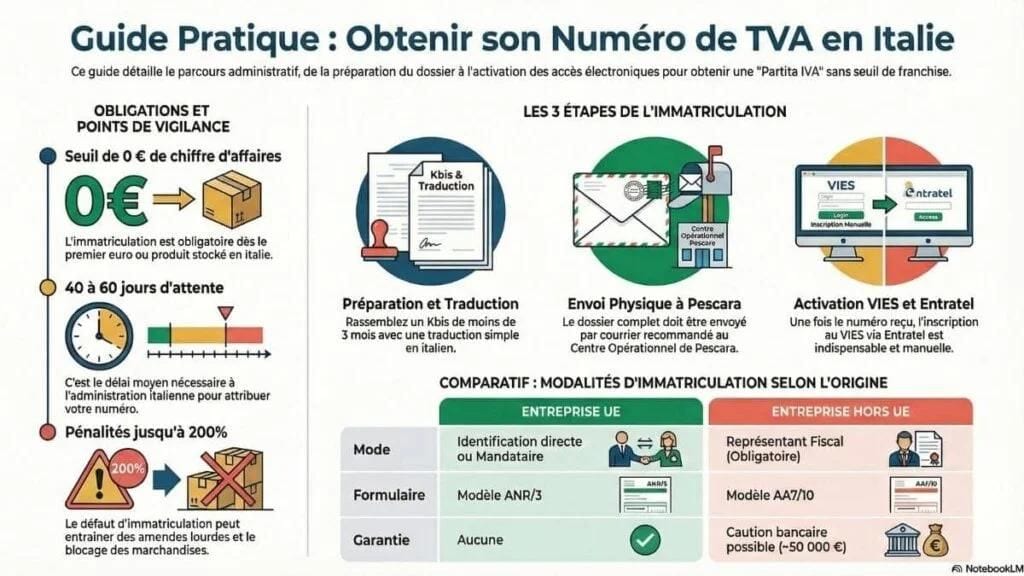
Step 1: choose the right registration route (EU vs non-EU)
The correct route depends on where your head office is located:
* EU companies: Form ANR/3.
* Non-EU companies: Form AA7/10 through an fiscal representative in Italy.
Step 2: prepare the application file
The Italian tax authorities usually require recent documents, less than 3 months old: company registry extract, articles of association, director ID, proof of taxable activity in Italy (customer contract, logistics contract, etc.) and a VAT taxable status certificate for the Italian VAT registration.
Step 3: send the file to the Centro Operativo di Pescara
For non-resident businesses, this is the competent office. You must send the complete file by registered mail with acknowledgement of receipt to the Pescara office address. It is old-school, but it is still the rule.
Step 4: obtain your Entratel access
Once your Partita IVA has been issued, you will receive your Entratel.
When is VAT registration mandatory in Italy?
For non-established businesses, there is no VAT registration threshold.
Which activities require VAT registration in Italy?
You must apply for an Italian VAT number if:
- You organise trade fairs, events or seminars in Italy.
- You store goods in Italy, for example Amazon FBA stock.
- You dispatch goods from Italy to businesses in other EU Member States (intra-Community supplies).
- You buy and resell goods in Italy.
- You import goods into Italy or export goods from Italy.
- You organise trade fairs, events or seminars in Italy.
Many other transactions can also require an Italian VAT number. If in doubt, speak to one of our VAT experts before starting operations in Italy: the registration request must be filed before your activities begin.
Direct VAT identification or fiscal representative?
| Criteria | EU company (France, Belgium, etc.) | Non-EU company (UK, Switzerland, USA, etc.) |
|---|---|---|
| Registration route | Direct identification or VAT agent | Fiscal representative required |
| Key form | ANR/3 | AA7/10 |
| Liability | The foreign company remains solely liable | The representative is jointly liable |
| Guarantee | None | Often a bank guarantee of around EUR 50,000 |
Codice Fiscale vs Partita IVA: what is the difference?
This is one of the questions I hear most often in client calls.
- Codice Fiscale: This is the company’s permanent administrative identifier, needed for contracts, banking, insurance and other formalities.
- Partita IVA: This is your business VAT number (starting with IT). It is used to invoice a customer in Italy and recover VAT.
Filing obligations: LIPE, Intrastat and the annual VAT return
Once the number is issued, the real compliance work begins:
- LIPE: quarterly electronic VAT communication. It is one of the Italian tax authority’s main monitoring tools.
- Annual VAT return: filed between February and April. This is where the annual position is reconciled and where you can request an Italian VAT refund.
- Intrastat: required for intra-EU flows. Monitor the thresholds carefully, especially acquisitions (€2,000,000). More details here: Intrastat in Italy.
- Compliance: Every Italian VAT return must be accurate. Agenzia delle Entrate systems cross-check data efficiently; errors do not stay hidden for long.
FAQ
How long does it take to get an Italian VAT number in 2026?
Allow between 40 and 60 working days from the filing of the complete application with the Centro Operativo di Pescara. This timeline can increase if the file is incomplete, translations are missing or during peak season (September to November). To protect your logistics schedule, for example an Amazon FBA stock launch, plan at least 3 months ahead of the planned start of operations.
What is the difference between Codice Fiscale and Partita IVA?
They are two separate but complementary identifiers :
- The Codice Fiscale is a permanent identifier for a legal or natural person, used for Italian administrative acts such as contracts, banking, insurance and leases.
- The Partita IVA is the business VAT number linked to economic activity (it starts with
ITfollowed by 11 digits). It appears on invoices and must be VIES-activated for intra-EU transactions.
A registered foreign company generally receives both during the registration process.
Can I start selling in Italy before receiving my VAT number?
No. VAT registration is mandatory from the first taxable transaction (first euro of sales or first stock shipment). Selling without a number exposes the business to penalties of up to 200% of the VAT due, customs blocks on goods and retroactive reassessment. If you have already started without a number, contact Eurofiscalis to manage a controlled regularisation.
Is my Italian VAT number automatically registered in VIES?
No, this is a frequent mistake. VIES registration (VAT Information Exchange System) requires an explicit request through the Entratel portal after the number is issued. Without VIES registration, intra-EU invoices may be rejected and you cannot apply the exemption on intra-Community supplies. Activation time: around 30 days.
What is the Ateco 2007 code and why does it matter?
The Ateco 2007 code is the Italian equivalent of the French APE/NAF activity code. It classifies your main economic activity and determines your specific VAT obligations: applicable VAT schemes, eligibility for reduced rates (4%, 5%, 10%), and additional filing obligations. A wrong Ateco code can lead to a rejected file or later reassessment. Examples: 47.91.10 for textile e-commerce, 46.90.99 for non-specialised wholesale trade.
Countries concerned
 (1).jpg)